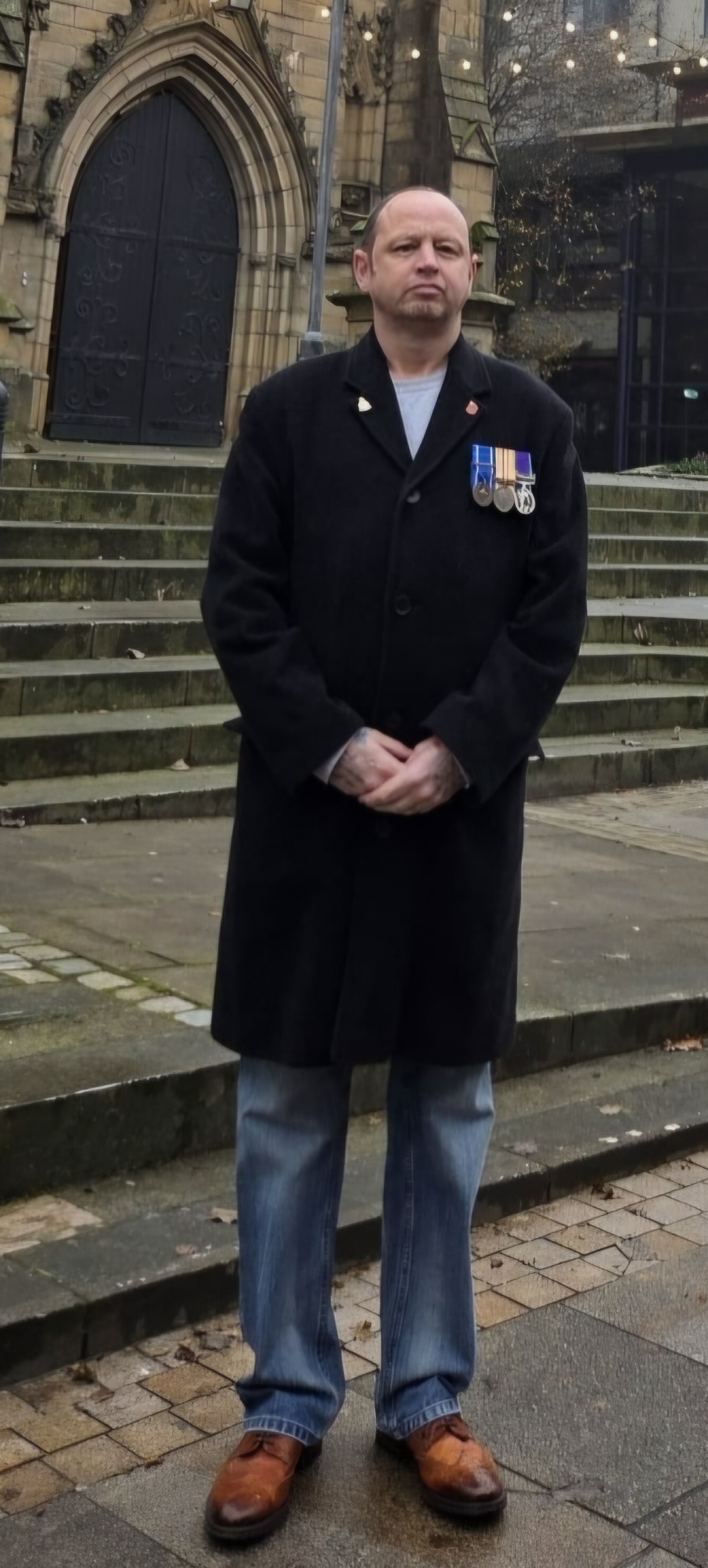
 For one Lancashire Teaching Hospitals colleague, Remembrance is about far more than wearing a poppy or observing a two-minute silence.
It is a deeply personal opportunity to remember friends who never came home, those who returned with lasting injuries and everyone who has sacrificed their lives in the service of others.
Having served in the British Army on two separate occasions, including deployments to Bosnia, Northern Ireland and Iraq, Craig Fielding, Student, Trainee & Placement Support Administrator at the Trust, understands the importance of Remembrance from personal experience.
Hailing from Preston, he first joined the Army as an infantry soldier, based in Andover, in 1996. During his initial period of service, he deployed to Bosnia before subsequently being medically discharged in the build up to serving in Northern Ireland.
After successfully appealing an initial medical discharge, he rejoined the Army and was based in Germany. Further deployments took him to Cyprus, Iraq and Northern Ireland before he completed his military career in Oxford.
He left the Army for a second time in 2008, having made the decision to start a family.
He said: “I'd seen too many mates who had families and then split up because of the demands of military life. You could be away training for six months, back for a period and then away again. We wanted to start a family, so I decided it was time to leave.”
Determined to challenge perceptions that he was only capable of a career in the military, he went on to study at the University of Lancashire.
There he pursued a law degree, spending five years working in the legal profession after graduating.
However, adjusting to civilian life was not always straightforward. He later experienced mental health difficulties, including post-traumatic stress disorder (PTSD), which was diagnosed some years after leaving the Army.
Sport became an important part of his recovery, providing an outlet and a way of managing his experiences. He returned to university to complete a master's degree in sports coaching, before taking on a role supporting former Armed Forces personnel in schools.
He joined Lancashire Teaching Hospitals in February 2022, initially working in pharmacy before moving into other roles. After discovering that working in theatres triggered difficult memories associated with his PTSD, he found a position that allowed him to use his own experiences to help others.
He now works in learning support, providing pastoral support to medical and nursing students.
He said: “Sport has always been my therapy. I've played it all my life, and whether it's watching, coaching or playing, it's something that really helps me.
“Now I'm in a position where I can support students in a similar way to the support I've received through my own counselling team.”
As Remembrance Day approaches, he believes the poppy should be seen for what it represents: an opportunity to remember and reflect, rather than something that should be used to make political statements.
For him, the significance is personal and dates back to his own experiences of military life and the friends he lost.
He explained: “I remember my mates who didn't come back every day. I don't need it to be November 11 to remember them.
“For me, this time of year is an opportunity for reflection. Not just on what has happened and how it has affected me, but on the First and Second World Wars and every conflict throughout history.
“People die in war. It's not good, but everybody reflects on it in their own way.”
He is particularly keen to emphasise that everyone should be free to decide how they mark Remembrance, whether that means wearing a poppy, attending a service or observing a moment's silence.
“Those people gave their lives so that we've got that freedom and that choice,” he said.
“So if people don't want to wear a poppy or take part in a minute's silence, that's their choice. But don't take that choice away from those of us who want to remember.”
Over the years, he has marked Remembrance in several different countries, including Northern Ireland and at Tyne Cot Cemetery in Belgium, one of the largest Commonwealth war cemeteries of the First World War.
However, it is the annual service in Preston city centre that holds the greatest significance for him.
He attends every year with his dad and other family members.
He said: “It's the one place where I truly feel I can reflect and remember.
“You see people there who you might only see once a year, and that's on Remembrance Sunday. It's about coming together with people who understand what it means.
“It's a very personal thing, but for me, being there in Preston is incredibly important.”
His own experiences have also encouraged him to look at how Lancashire Teaching Hospitals can further recognise and support colleagues who have served in the Armed Forces.
Having spoken to the Trust's Armed Forces champion, Debbie Tickle, he has been sharing ideas about developing greater support for veteran staff.
He believes there is an opportunity to bring together former service personnel working across the Trust, creating a stronger community where colleagues can share experiences, offer support and help those making the transition into civilian employment.
He said: “There are a lot of people who have served in the Armed Forces working here.
“When you leave the military, you hand in your ID and that's it. Thank you and goodbye. There's still a lot more that could be done to support people as they make that transition.
“We have a huge opportunity here. There are people with shared experiences who could support each other, and I think it's important that we make the most of that.”
For him, the message of Remembrance ultimately comes back to the people behind the poppy.
He said: “It's about remembering brave people. The people who didn't come back, but also those who did come back and weren't quite the same.
“It's not political, it's not about winning votes and it's certainly not about creating hatred.
“It's simply about remembering.”