Help us improve care
for people with Chronic Kidney Disease
Join our Patient and Public
Involvement and Engagement (PPIE) group
Background:
- Chronic Kidney Disease (CKD) affects 5-6% of adults in the UK, and it can be detected through blood and urine tests.
- People with CKD have increased risk of Kidney Failure, cardiovascular disease, hospitalisation and death Early detection of CKD is important for timely management to slow disease progression and prevent complications.
- All patients with CKD should be coded in their primary care electronic health records. Correct CKD coding will automatically trigger electronic alerts that enable systematic patient management, including regular blood and urine tests, blood pressure optimisation, cardiovascular risk reduction, and vaccinations, etc
- Unfortunately, only around 3 out of 4 patients have been given correct label (coding) of CKD on GP electronic health record, which means around 1 out of 4 patients are not getting the appropriate care they should be receiving.
This Project Aims to:
To develop a CKD detection algorithm...
...
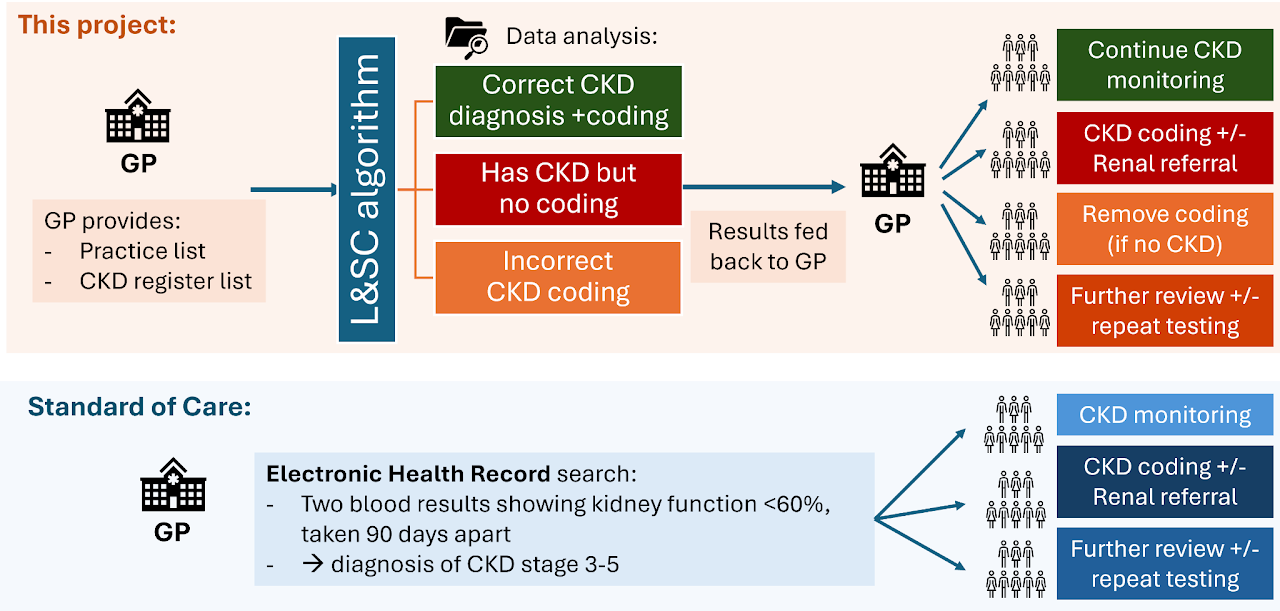
that reviews all available kidney test results over time to determine whether a person truly has CKD and whether this is correctly recorded (or “coded”) in their primary care electronic health record (EHR)

To test and refine the CKD detection algorithm...
...
in collaboration with primary care providers and data scientists to improve its accuracy. The algorithm will be adjusted to achieve the best possible balance between sensitivity and specificity in identifying patients with confirmed CKD and therefore enhance accurate coding in primary care EHR.

To analyse inequalities in kidney care...
...
by comparing patients who have CKD correctly recorded (“coded”) in their primary care records with those who do not. The comparison will consider factors such as socioeconomic status, age, sex, and ethnicity.
Patient and Public Involvement and Engagement (PPIE)
What is Patient and Public Involvement and Engagement (PPIE)?
Patient and Public Involvement and Engagement (PPIE) in research means that we do the research ‘with’ the patients and public, not just ‘for’ or ‘about’ them. We hope to involve patients and public to help us design, conduct and disseminate the results of the research project.
What do we want patients/ the public to helps us with?
We want to hear from those affected by CKD, their carers and the public to help us shape and improve our research project. We want to ensure what we are doing is useful and beneficial to the patients and public, and the project is designed in a way that is acceptable to most patients.
What information do we collect about you?
In order to help us involve people from diverse background, we want to collection information on demographic characteristics, including age, gender, race and lived experience of CKD when we invite people to join our Public Involvement activities. These information will be collected in the invitation to potential participants in PPI activities. You may opt in or opt out of providing these information. Depending on these characteristics, respondents will be selected and invite to participate, ensuring the group would be as representative as possible of the research population in Lancashire & South Cumbria.
What kind of PPIE activities do we plan to do?
Face-to-face (and possibly online) discussion session about the design of the research project. Before the session, all contributors will receive a summary of the CKD-SPAN project. The session will aim to collect comments, thoughts and ideas about the research project.
Calum, our PPIE lead in the Trust, will be there to facilitate the session to ensure it runs smoothly
During the sessions, you may expect:
An introduction to the research topic
Opportunities to ask questions
Opportunities to share your views on our research based on your lived experience
Will I be reimbursed for the time and travel expenses?
Yes. Attendees will be paid for their time (e.g. £27.50 per 1-hour session) for participating the involvement activity.

Interested in taking part?
Fill in the short Expression of Interest form
(5-10 minutes) via the QR code and return to
Questions?
For any queries, please contact ckdproject@lthtr.nhs.uk or leave a message on 01772 522031.
ckdproject@lthtr.nhs.uk | Lancashire Teaching Hospitals NHS Foundation Trust | 01772 522031