Health Improvement Plan
Lancashire Teaching Hospitals has set up a Health Improvement Plan, which is a comprehensive strategy aimed at reducing health inequalities across our region. The plan is a testament to the organisation’s unwavering commitment to fostering a healthier, fairer society where everyone can thrive.
Aims of our Health Improvement Plan
Through our Health Improvement Plan, we aim to:
-
Work with local partners to address the social determinants of health that can result in people experiencing health inequalities and influence health outcomes e.g. education, employment, housing and community support.
-
Create a supportive network that promotes health and wellbeing at every stage of life.
-
Offer a roadmap for creating a healthier, more equitable society in Lancashire and South Cumbria.
-
Ensure that we engage with our residents, listen to their needs, and adapt our strategies to ensure that we are making a meaningful impact.
What are health inequalities?
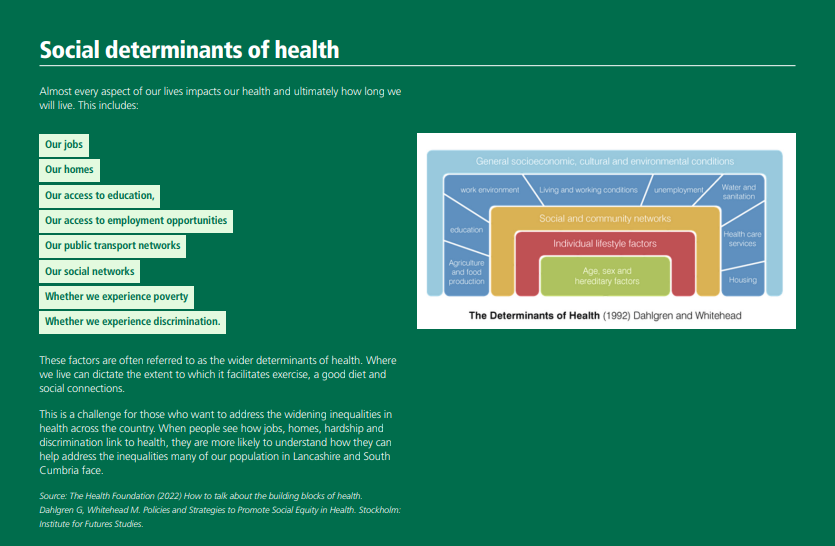 Health inequalities are systematic differences in health that affect various groups of people. Health inequalities are a persistent challenge, deeply rooted in the social, economic, and environmental conditions in which people are born, grow, live, work, and age. These disparities are not only unjust but also preventable. The Trust’s mission is to address these inequalities head-on, ensuring that every individual, regardless of their background or circumstances, can lead a healthy and fulfilling life.
Marmot Review (2010)
The Marmot Review (2010) was a strategic review of health inequalities that has provided us with a clear roadmap for improvements. These recommendations lie at the heart of our Health Improvement Plan.
At Lancashire Teaching Hospitals, we are dedicated to transforming into a ‘health improvement organisation’ that not only treats illness but also actively promotes health and wellbeing.
Why is it important that we take action to reduce health inequalities?
Across the Lancashire and South Cumbria region there are high levels of deprivation and persistent poverty in coastal areas, rural communities as well as in its towns and cities, all of which contribute to unfair and wide inequalities in health and poor health.
We are committed to working collaboratively with our partners and the community to tackle the root causes of health inequalities and have aligned our work to that of the Lancashire and South Cumbria Integrated Care Partnership Strategy 2023–2028 and the life course approach of Starting well, Living well, Working well, Ageing well and Dying well. By focusing collectively on prevention, education, and creating supportive environments, we aim to ensure that everyone has the opportunity to lead a healthy life.
Health Inequalities in Lancashire and South Cumbria
The Lancashire and South Cumbria region has a population of 1.7m people. Within that, Lancashire Teaching Hospitals is a specialist provider serving people from across the whole of Lancashire and South Cumbria and it is important that we consider the extent of the health inequalities across our region, as well as the local Central Lancashire footprint.
Local statistics for Lancashire and South Cumbria highlight the extent of health inequalities in our region. We face a number of challenges in Lancashire and South Cumbria which have a direct impact on people’s health and wellbeing. We have communities across our region that face some of the greatest disadvantages seen anywhere in the country and the health inequalities across different parts of our geography are stark.
- 31% of our population live within the 20% most disadvantaged communities in the UK. This varies significantly across Lancashire and South Cumbria (LSC). In Blackpool, 70% of the population live within the 20% most deprived areas, whereas other areas of LSC experience less deprivation.
- Up to 25% of children and 20% of over 65s are living in poverty.
- 13% of people live in fuel poverty and are unable to afford to heat their homes, which is higher than the national average of 10.6%.
- 17% of people in Pennine Lancashire are part of a minority ethnic group.
- Approximately 40% of ill health in Lancashire and South Cumbria is caused by smoking, not taking enough exercise, being overweight and taking illegal drugs.
- Only around one fifth of adults are meeting the recommended levels of physical activity.
- Across Lancashire and South Cumbria, there are high levels of people living with mental health conditions including depression.
- There are high levels of people living with other long term health conditions including cardiovascular disease, heart failure, hypertension, asthma and dementia.
- Within the local population, there are high rates of alcohol, smoking, and respiratory related admissions, obesity and digestive related conditions, and late cancer diagnosis.
- Home ownership, employment rates, and levels of education vary enormously across the region.
- Quality and availability of housing differs significantly across different parts of Lancashire and South Cumbria.
- Crime, antisocial behaviour, and poor experiences of community safety are greater in the most disadvantaged neighbourhoods.
Source: Lancashire and South Cumbria ICB
Access to services, experience of care, and health outcomes are worse for those people living in the most disadvantaged communities. And there are significant differences in the number of years people can expect to live a healthy life across our area.
We know many people in Lancashire and South Cumbria could be living longer, healthier, happier lives than they currently do, and we know we must do everything we can to address these inequalities.
Life expectancy across Lancashire and South Cumbria 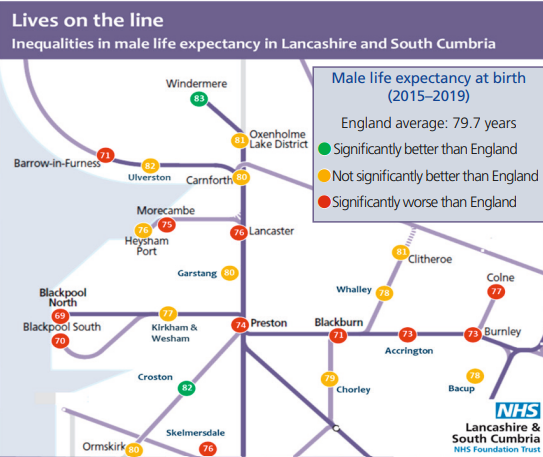
Life expectancy in Lancashire and South Cumbria is lower than the national average – by almost a decade in some areas. There is also a large variation in the number of years people can expect to live a healthy life. Babies born in this area today have a healthy life expectancy that is lower than the expected state pension age of 68. In some areas, healthy life expectancy is as low as 46.5 years, although this varies significantly across our communities.
Diseases that contribute to the gap in life expectancy between the most and least deprived areas are circulatory disease, cancer, respiratory conditions. Around 21,000 people across Lancashire and South Cumbria who are currently registered with a GP practice have 5 or more long-term health conditions, and a disproportionate number of these are from the areas of greatest disadvantage.
Across the region, there are significant variations in life expectancy as a result of health inequalities and we must collectively take action to ensure fair, equitable health services are available to everyone across the region.
Health and Lifestyle Factors Affecting Health Inequalities 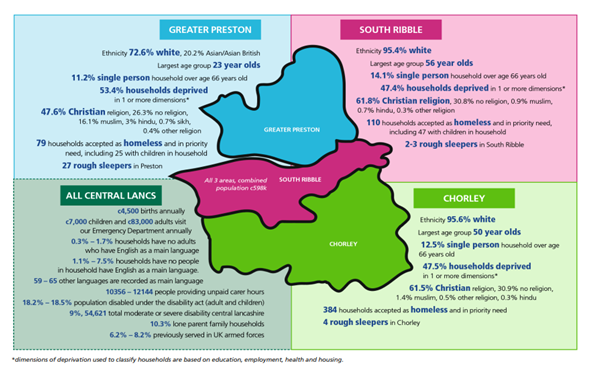
Health behaviours, such as diet and exercise, can improve or damage the health of individuals. These are determined by the choices available in the places where people live, learn, work and play. Behaviours such as stopping smoking, moderation of alcohol intake, healthy eating, physical activity, sexual practices and disease screening can reduce the risks of developing serious illnesses such as cancer, heart disease and type 2 diabetes. When compared to the England average most health risk factors are higher in Central Lancashire.
Our Health Improvement Plan aims to take action to reduce the impact of some of these health and lifestyle factors. You can find out more about the actions we intend to take to tackle health inequalities in our Health Improvement Plan.
Core20PLUS5 Framework - Targeting the most deprived communities
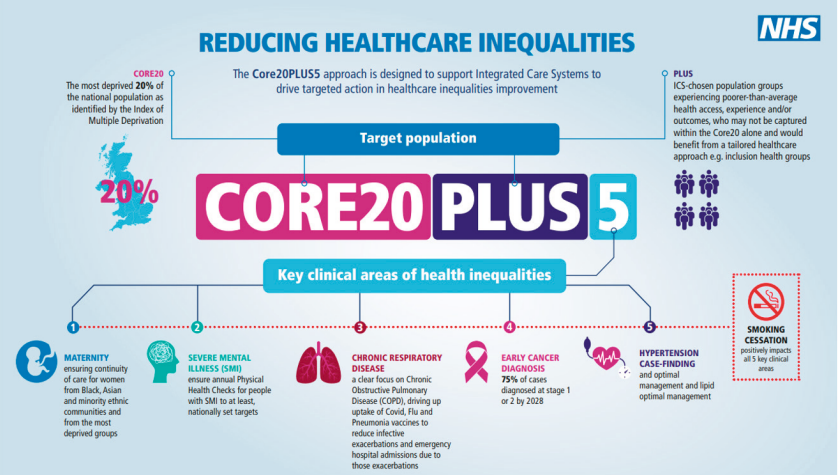
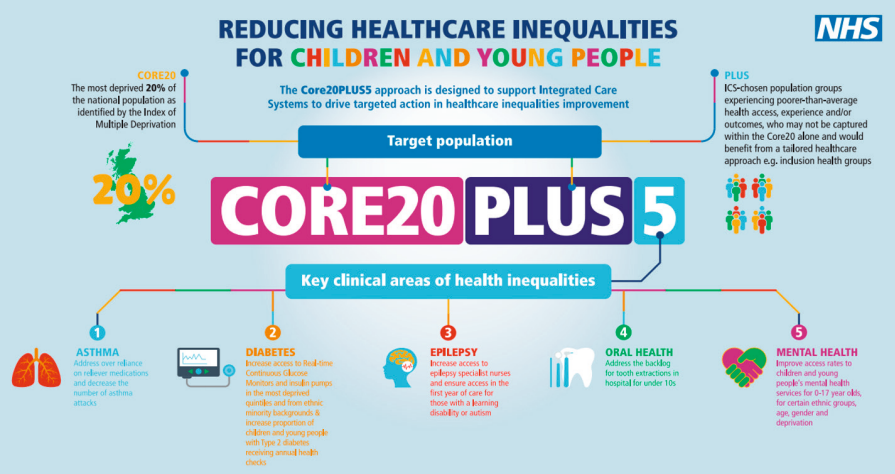
Core20PLUS5 is an NHS framework to inform action on reducing healthcare inequalities at a national and system level based on the theory of social determinants of health. The approach defines a target population – the ‘Core20’ most deprived 20% of the population, ‘PLUS’ population groups that are at increased risk within our area and identifies ‘5’ focus clinical areas requiring accelerated improvement and drives action in healthcare inequality improvement. The Core20PLUS5 framework forms the basis of our clinical interventions for adults.
Our Health Improvement Plan has two key areas aimed at both adults and children. You can view the priorities identified for both groups below.
Core20PLUS5 - Adults
Our work with adults will focus on several clinical areas of health inequalities including:
- Maternity
- Severe Mental Illness (SMI)
- Chronic Respiratory Disease
- Early cancer diagnosis
- Hypertension
- Smoking cessation.
Core20PLUS5 - Children
Our work with children and their families will focus on several clinical areas of health inequalities including:
- Asthma
- Diabetes
- Epilepsy
- Oral Health
- Mental health.
You can read more about the work we are doing in each of these areas of focus to tackle health inequalities in our Health Improvement Plan.
Partnership Working - Working with our local partners to tackle health inequalities
Successfully reducing health inequalities requires us to work in partnership with stakeholders in and outside of health. Across partner organisations there is a shared ambition, but also individual responsibility where each organisation can help to connect either data, intelligence or programmes of work that have the same aims.
The LSC place-based health inequalities strategy is developed in partnership between the Lancashire and South Cumbria Integrated Care Board (ICB) and Lancashire County Council (LCC) through the Health and Wellbeing Boards. There is a Health and Wellbeing Board for Chorley and for Preston.
Voluntary, Community, Faith and Social Enterprise Partners (VCFSE)
There are approximately 50 VCFSE partners actively working with us across Central Lancashire and work is ongoing to engage with more partners. We are working with partners to support families in key areas including carers, bereavement, community support, health promotion, and support.
Working jointly together under the Lancashire and South Cumbria Integrated Care Partnership Strategy, we have a joint vision for a safer, fairer and healthier Lancashire. There are 3 priorities that have been identified including:
- Best start in life - Achieving the very best start in life for our children, young people and families.
- Happier minds - Reducing the chances of heart disease, stroke, diabetes, dementia and cancer.
- Healthy Hearts - Improving wellbeing and reducing addiction, self-harm and loneliness.
Population Health Approach - Improving health outcomes across our population
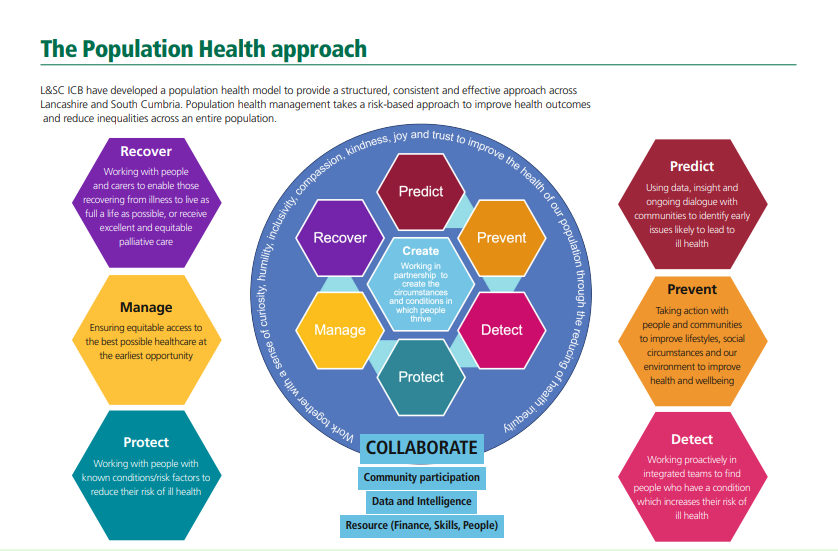
Lancashire and South Cumbria ICB have developed a population health model to provide a structured, consistent and effective approach across Lancashire and South Cumbria. Population health management aims to improve health outcomes and reduce inequalities across an entire population. The diagram below explains the ways in which a population health approach is being implemented across Lancashire and South Cumbria to reduce health inequalities.
How will we deliver our Health Improvement Plan?
Effective delivery of our work around health inequalities will rely on 3 key principles that will be threaded throughout our Health Improvement Plan to ensure our organisation can embed, sustain, change and grow our understanding in reducing health inequalities.
Key principles
- To give everyone a ‘health equity attitude’ - Through better awareness, understanding and visibility we can then act to improve access, experience and outcomes for our patients.
- To actively engage with local communities to improve services for their needs - Engaging our local communities and co-producing improvement must be at the centre of this work. We need to genuinely listen to understand with an appreciation that our communities are best placed to co-produce the solutions to the problems that we seek to solve.
- To take a population health approach to improvement work - This approach will be effective in enacting sustainable change that makes an impact to the group most in need.
How will we achieve this?
- Health inequalities education - a new approach to health equity education.
- Health inequality data visibility - mandated collection, sharing and use of data to understand inequalities.
- Active health promotion - for patients, families and colleagues.
- Connection – Understand our role as an anchor institution and the Social Values Framework.
- Lived Experience - Learning from the experience of people on whom a social or combination of issues has had a direct impact on the person.
- Co-production - A way of working together underpinned by principles that support inclusion, equity, shared decision and ownership for what is produced and the impact of has at all levels, especially strategically.
- Structure - Following the 6-step approach for population health intervention.
- Data led - Using data to drive areas that require improvement.
- Focussed - Targeted population specific solutions, not generalised solutions that may not be effective.
You can read more about the key health improvement projects we are undertaking with local communities to tackle health inequalities across Lancashire and South Cumbria in our Health Improvement Plan.
Our role as an anchor institution
According to the Health Foundation, anchor institutions are large organisations that have a significant role to play in their local community. The size, scale and reach of the NHS means that it influences the health and wellbeing of local communities simply by being there.
The Health Foundation's ‘Building Healthier Communities - The Role of the NHS as an Anchor Institution’ report identifies five ways in which NHS organisations act as anchor institutions:
- Employment
- Procurement and Commissioning
- Use of capital and NHS estates
- Environmental sustainability
- Partnership Work with place-based partners.
The Health Foundation argues that the NHS must use its actions and considerable influence to have a positive impact on the health and wellbeing of the communities it serves by placing social value at the heart of its daily operations. That is why our role as an anchor institution is at the heart of the actions we are taking to tackle health inequalities in Lancashire and South Cumbria.
Social Value Strategy 
The importance of social value
Social value is a ‘catch-all’ term used to describe the difference we can make to the communities we provide services to. Social value matters because it is the right thing to do.
Social value encompasses all activity across our organisation. It goes beyond the financial bottom line; it includes employment, training and education, commissioning or procurement, investment and service delivery. It also includes how we go about doing our work, such as the ethical approaches we consider, the community engagement we undertake through to the collaboration we have with partners and wider stakeholders.
The purpose of social value is to deliver an impact within the community. This can be through reducing health inequalities, increasing the diversity of our workforce, retaining and attracting talent and skills to the area, improving the health and wellbeing of our communities and colleagues, through to increasing economic prosperity in the region and improving the environment.
You can find more information about all the great work that is being done with local communities in our Social Value Strategy Framework.
Where you can find support
- Useful Documents
- Local Support Services - Mental Health
Local Support Services – Mental Health
There are several organisations that provide support to their patients and families in Lancashire and South Cumbria. You can find more details below about how to contact these services.
Mental Health Support at LTHTR
At LTHTR, we recognise that mental health is as important as physical health.
Urgent Support
Initial access to urgent mental health support is available via the Lancashire and South Cumbria Mental Health Crisis Line on 0800 953 0110, which operates 24/7 for people of all ages.
Additional Support Services
Wellbeing Helpline & Texting Service
0800 915 4640
Text HELLO to 07860 022846Samaritans
116 123
www.samaritans.orgPapyrus HOPELINEUK
0800 068 4141
www.papyrus-uk.orgLancashire Mind
www.lancashiremind.org.ukHub of Hope
www.hubofhope.co.uk - Local Support Services - General
Lancashire Health Hub
Lancashire Health Hub - Patient information about local health services in Lancashire and South Cumbria and professional advice for colleagues.
- Smoking Cessation Services
Support for patients
Smokefree Lancashire offers face-to-face support to quit smoking for anyone over 12 who lives in the county.
Visit their website for more information about how to make a patient referral and the range of advice and support available to patients.
Visit: Smokefree Lancashire Website
- End of Life Care
End of Life Care
Lancashire Teaching Hospitals is committed to delivering high-quality, compassionate care at the end of life.
Contact:
Rosie Ingham - End of Life Clinical Educator and Quality Improvement Facilitator
- Patient and Community Groups
Age Concern - Living Well Support Service
Age UK Lancashire’s Living Well Support Service is designed to help older people return home safely after a hospital stay, prevent unnecessary hospital admissions, and provide urgent support following a significant life event.
Email: advice@ageuklancs.org.uk
Telephone: 0300 303 1234Website: Age Concern Living Well Support Service
Living Better Lives in Lancashire Service
Living Better Lives in Lancashire is Lancashire County Council's vision for Adult Social Care, offering support to Lancashire residents to live as independently as possible. They offer advice, information, and signposting to support, which is close to where people live, to prevent, reduce or delay the need for formal social care support. They offer short-term support (up to 6 weeks) to enable people to regain skills, confidence and independence, that they can live at home safely, where it is possible for them to do so.
Website: Living Better Lives in Lancashire Service
Help In Preston
Help in Preston is here to signpost you to the advice and services you need to help you live a better life. The Preston Inclusion Group work with the local community to bring you local services.
On their website, you can find information on:
How to get immediate crisis support
Help In Preston Service Directory
Visit the Service Directory for a full list of service providers available. You can find a full list of services and projects offering support to local residents in the service directory. You can either use the search function or select categories for your chosen service. If you are looking for organisations in a particular neighbourhood you can look at and search the map view tab.
Work Well Preston
Work Well is a new pilot run by Active Lancashire that aims to help people with low physical health and health conditions to start and stay in work. This service is free and voluntary, and as part of the offer, participants will have access to a Work and Health Coach/Mentor.
Together, they will agree realistic and reasonable next steps that can form part of a personalised support plan. This can include helping you to improve your physical and or mental health. Work and Health Coaches will consider the full range of available local support and provide signposting, tailored to individual need.
The Preston Work Well project is particularly interested in working with the following groups: people of Black, Asian, or Minority Ethnic backgrounds, Ex Offenders, Young People and Women, who also meet the criteria.
Lancashire Warm Spaces Grant Scheme
This grant programme has been set up for local organisations and groups within the voluntary, community, and faith sector, as well as for parish and town councils, to support the creation and improvement of warm and welcoming spaces for residents, focussing on those most in need.
Warm spaces are held in a range of venues across Lancashire and offer a warm, safe, and welcoming space for people to spend time in. Every warm space is different. Many provide basic refreshments such as tea and coffee, some host activities like keeping fit and crafting, while others provide computers, additional services and signposting.
Visit the Lancashire County Council website for more information on the Lancashire Warm Spaces Grant Scheme.
Preston Muslim Forum - The Hamara Centre
The Hamara Centre, Preston is home to several active community groups and operated in partnership with the Preston Muslim Forum (PMF). Located on Castleton Road in Preston, the centre primarily supports the BAME community while welcoming individuals from all cultural and ethnic backgrounds.
As a drop-in facility, it provides vital support that fosters increased knowledge, life skills, and confidence in managing everyday challenges. Services include advice and guidance on welfare benefits, consumer rights, debt management, housing, and employment.
The PMF also acts as a first point of contact for community members seeking assistance with a wide range of issues. This includes practical support such as form completion for government and local authority benefits, liaison with agencies to resolve both basic and complex queries, appeals and reviews, medical and work capacity assessments, and financial advice. Their holistic approach extends to social housing support, referrals and signposting for cases involving debt, domestic violence, homelessness, immigration, and sensitive care for individuals with special needs.
Visit the Preston Muslim Forum website for more information.
Pukar Resource Centre - Preston
The Pukar Disability Resource Centre aims to work with disabled people, their carers and families to maintain their independence, and to make an accessible centre in Preston city centre, where disabled adults and their carers can access information, resources, education and training, using trained staff and volunteers.
Visit the Pukar Resource Centre website for more information.
- Support for Carers
A carer is anyone who looks after a family member, partner or friend who needs help because of their illness, frailty, disability, a mental health problem or an addiction and cannot cope without their support. The care they give is unpaid.
At Lancashire Teaching Hospitals we welcome and value the important support carers provide for their loved ones, and we also appreciate that you know the patient best and we want to ensure we provide the best care and experience possible so we are committed to working with you.
Our commitment is listed in our Carers Charter.
And to ensure we try and make your visit as easy as possible we have also put in place our Carers Lanyards, put up beds and a Carers Forum which offers support and guidance from staff and other carers and covers services both inside the hospital and within the community.
Visit the Carers page for more information.
- Widening Participation - Jobs and Apprenticeships
The LTH Health Academy provide a wide range of courses and programmes to help support employability and careers.
Our wonderful Team at the LIFE Centre offers a high standard of education and support in preparing all individuals for the workplace and enhancing their employability by running various courses and programmes that support different groups in society.
The Trust’s Widening Participation and Apprenticeships team offer advice and assistance with:
- Apprenticeships
- Careers Ambassadors
- Employability programmes and support
- Functional skills (English and Maths)
- Work experience.
To view The Health Academy website to learn more about what we offer please click here.
- Safeguarding
The Safeguarding Team provides consultation, support, advice, supervision and training across Lancashire Teaching Hospitals NHS Foundation Trust.
The LTH Safeguarding team can provide some great advice on how to deal with a range of areas including:
- Trauma informed care
- Multi-agency Risk Reduction Assessments (MARRAC) - for high risk domestic abuse cases
- Mental Capacity Act (MCA) and Deprivation of Liberty Safeguards (DoLS)
- Domestic abuse
- Sexual violence
- Modern Day Slavery/ Human Trafficking
- PREVENT
- Training
- Safeguarding Champions
- Housing
- ED Navigator.
Contact Details
External number: 01772 523676
Duty Email: Safeguarding.Duty@lthtr.nhs.uk
Adult Email: Adult.Safeguarding@LTHTR.nhs.uk
Child Email: Child.Safeguarding@LTHTR.nhs.uk