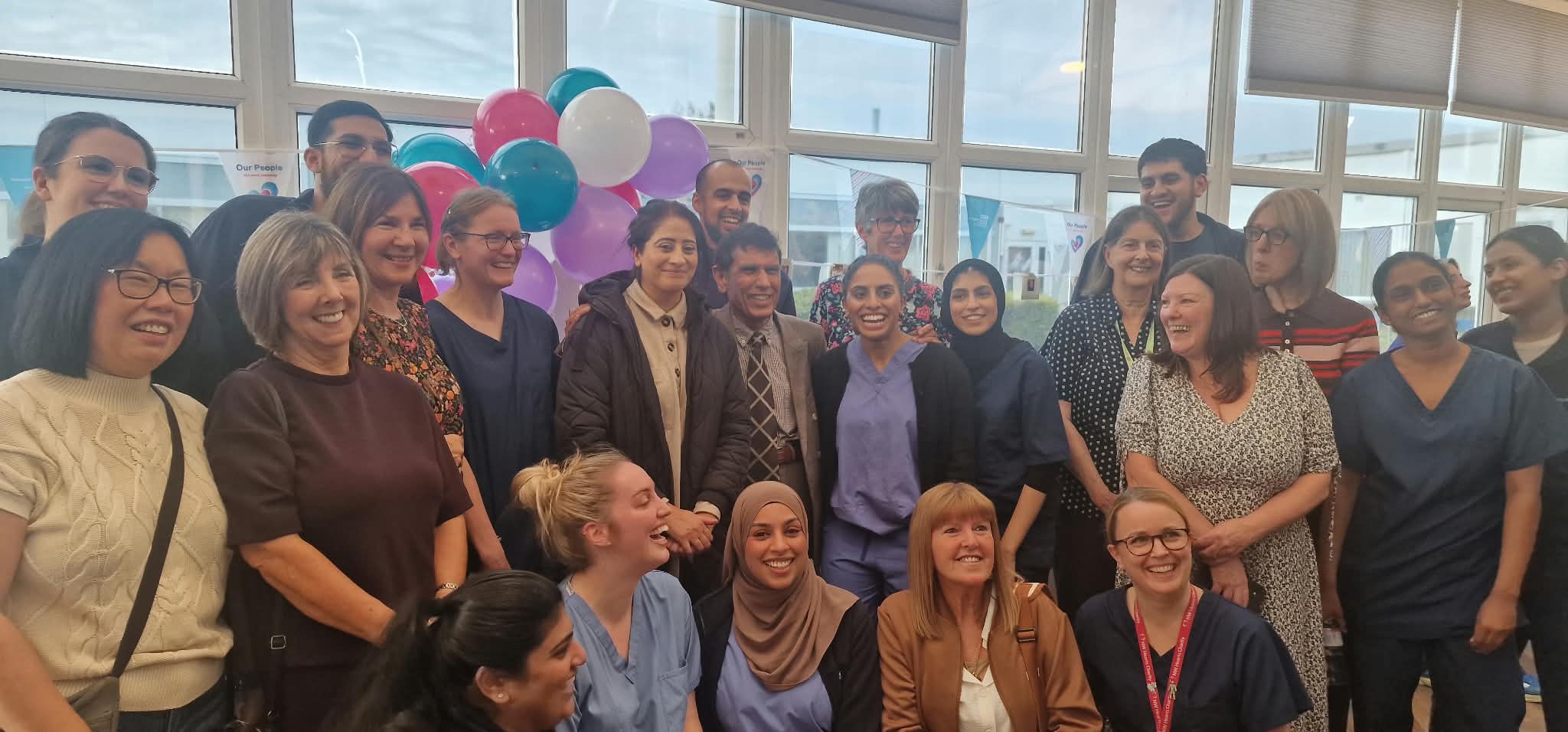
Dr Khan can be seen in the middle, wearing a suit with a tie.
A consultant cardiologist who helped transform cardiac care for patients across the county is preparing to retire after more than 30 years with Lancashire Teaching Hospitals NHS Foundation Trust.
Dr Sarfraz Khan joined the Trust in 1996 as its sole Consultant Cardiologist, at a time when patients often had to travel to Blackpool or Manchester for specialist cardiac investigations and procedures.
Recognising the need to bring more services closer to home, Dr Khan played a leading role in establishing the Trust's first Cardiac Catheterisation Laboratory at Royal Preston Hospital, which opened in summer 2006.
Working alongside Radiology Director Margaret Mallon and Principal Clinical Physiologist Suzanne Gifford, he helped turn the vision into reality.
The team visited cardiac centres in Italy, Germany and Spain to learn from emerging best practice before developing a service for local patients.
For the first 10 years at Royal Preston Hospital, Dr Khan travelled to Blackpool one day a week to carry out invasive procedures on his patients while the Trust worked towards establishing its own facilities.
The opening of the first laboratory was a significant milestone, bringing diagnostic angiography and pacemaker procedures closer to home and reducing the need for patients to make lengthy journeys for treatment.
Speaking at a special retirement celebration in a packed Charters Restaurant, Dr Khan said: “You have to persevere. You have to keep pushing, explain what you want to achieve and make the case for it.
“The patients appreciate the service they receive, and that helps. It benefits the Trust because it means we can provide more services locally and continue developing our services further.”
Over the past 30 years, the department has grown considerably. What began as a single cardiac catheter laboratory with a four-bedded recovery bay has developed into a fully-fledged department with two cardiac catheterisation laboratories.
A major expansion and refurbishment in 2010 and 2011 helped create the two-laboratory facility at Royal Preston Hospital, while the consultant team and wider workforce have continued to grow alongside increasing demands.
Dr Khan has witnessed and helped drive that transformation, including the recruitment of additional consultants and the development of services to provide more specialist cardiac care.
Today, the department continues to evolve, with further investment planned to increase Consultant numbers and upgrade laboratories, always aiming to expand the quality and range of treatments available locally.
Asked what he was most proud of during his time at the Trust, Dr Khan said building up the cardiology service and seeing how far it had progressed were among his greatest achievements.
He also paid tribute to the colleagues who had supported him throughout his career, many of whom came together to mark his years of dedicated service.
He said: “I've been grateful to everybody I've worked with. I appreciate all the support and everything that people have done.”
Although he is retiring from his role at Lancashire Teaching Hospitals in November, Dr Khan is not planning to stop working altogether.
He hopes to spend more time travelling before undertaking some clinic work in Islamabad, returning to the UK for periods in between.
He also intends to continue enjoying his interests in travelling and hiking.
His immediate travel plans include a trip to Bermuda, followed by a visit to Canada to see his brother.