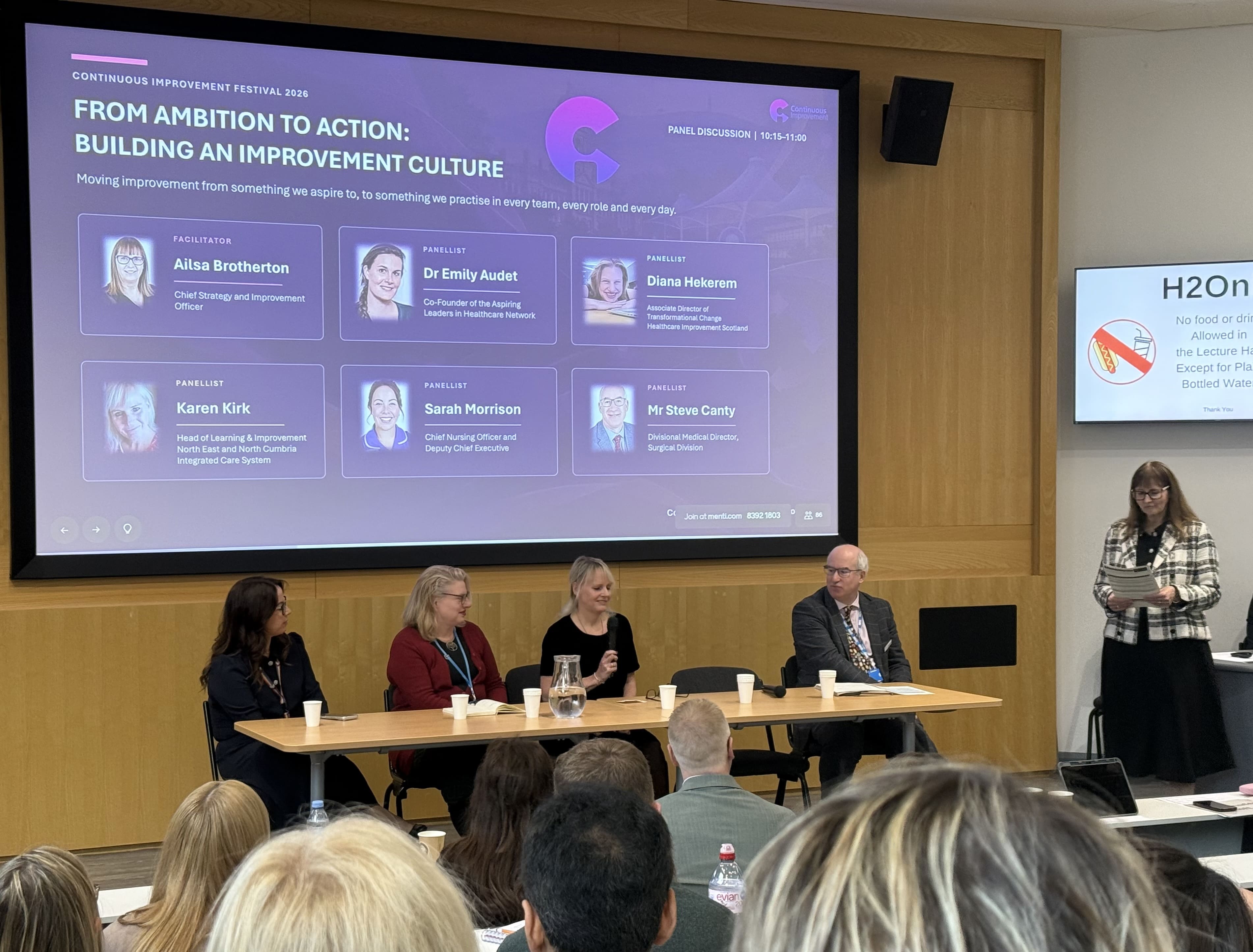
Lancashire Teaching Hospitals' inaugural Continuous Improvement Festival brought together colleagues, partners and improvement experts to celebrate innovation, share learning and drive better outcomes for patients.
The three-day festival began on Monday 12 October with the Trust's flagship Continuous Improvement Conference at Royal Preston Hospital, which welcomed colleagues from across the organisation for a programme of keynote speeches, panel discussions, breakout sessions, networking opportunities and a showcase of improvement projects.
The conference opened with presentations from Ailsa Brotherton, Chief Strategy and Improvement Officer, and Sarah Morrison, Deputy Chief Executive Officer, who reflected on the Trust's improvement journey to date and outlined ambitions for the future.
Delegates also heard from guest speakers Richard Wylde and Dr Claire Kenwood from Leeds and York Partnership NHS Foundation Trust, who presented on relational coordination and the role strong professional relationships play in improving organisational performance and patient outcomes.
A panel discussion, From Ambition to Action: Building an Improvement Culture, explored how organisations can embed continuous improvement into everyday practice, while Arnie Bhowmick, Deputy Medical Officer, and members of the Continuous Improvement Team led a session examining what continuous improvement means for colleagues working across the Trust.
The conference also featured two rounds of breakout sessions, giving attendees the opportunity to explore a range of topics including:
- Health inequalities, anti-racism and maternity improvement
- Patient voice and co-production
- The Lancashire Improvement Method in practice
- Research and service improvement
- Simulation and improvement
- The Modern Productives Series and staff engagement
- Audit versus improvement methodology
- Blended learning and capability building
Sessions throughout the day focused on practical learning and sharing innovation, including an exploration of the Lancashire Improvement Method and an Improvement Show & Tell, where teams showcased successful projects and the impact they have delivered for patients and colleagues.
On Tuesday, the festival continued with practical workshops focused on quality improvement projects and measurement for improvement. On Wednesday, colleagues took part in a cross-site patient safety visit at Royal Preston Hospital and Chorley and South Ribble Hospital, providing an opportunity to see improvement methodologies in action and share best practice across services.
The festival is also recognising outstanding improvement work taking place across the organisation, with awards sponsored by Vivup celebrating the best conference posters and improvement boards, with the first prize going to “See & Sort Stream Initiative” by Dr Madeleine Truscott, second to "Optimising the Pre-term Baby” by Katherine Noble, Aubrey Makhalira, Maria Esslinger Raven, Emma Croft, Julie Guiver, Suresh Madaiah, Andrea Whitehead and Jane Boscolo-Ryan, and third going to “Improving Soft Tissue Knee Management Through Implementation of the MRI Knee Assessment Tool (mKat-Tool) in Therapy Trauma Clinic” by Dave Wiseman and Daniel Carroll.
Speaking at the conference, Ailsa Brotherton described how Lancashire Teaching Hospitals has developed a consistent organisation-wide approach built around leadership, measurement, capability building and selecting the right improvement programmes. She highlighted the importance of placing patients at the centre of improvement work and ensuring leaders actively engage with frontline teams to understand challenges and support change.
Ailsa also outlined the Trust's growing investment in improvement capability, including training quality improvement experts and embedding improvement skills into everyday practice: "Our long-term ambition is to make improvement part of every employee's role, enabling staff to do their jobs while continually improving how they are done. With strong foundations now in place, our focus is on scaling what works, strengthening collaboration and creating a culture where staff feel confident to test changes and deliver sustainable benefits for patients."
Sarah Morrison highlighted the importance of improvement science in delivering high-quality healthcare: "Improvement science must become part of how we operate as an organisation. By listening to our staff and patients, empowering teams to test new ideas and creating an environment where people feel confident to challenge existing ways of working, we can continue to improve care, experience and outcomes for the communities we serve."