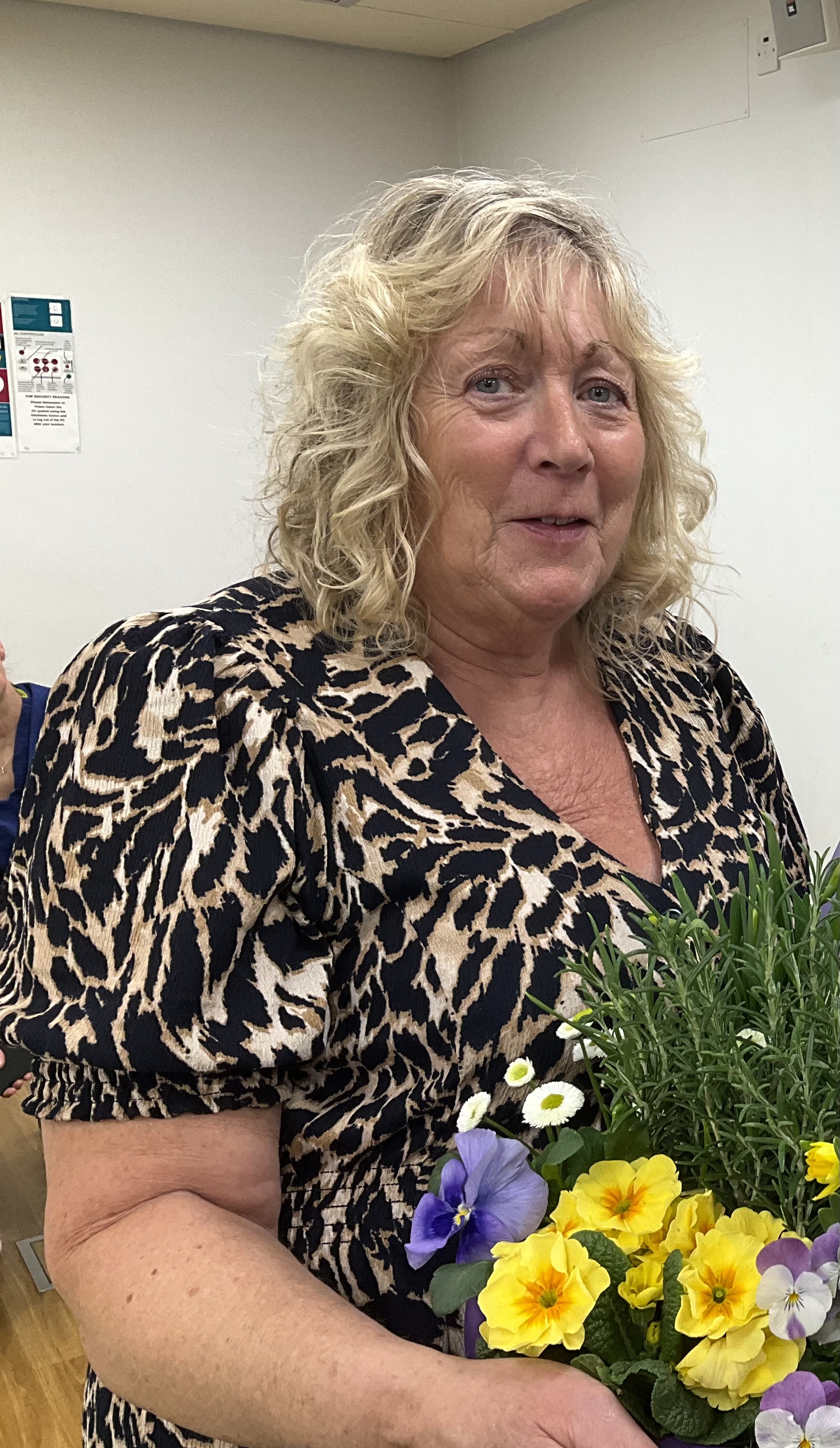
 After four decades at Chorley and South Ribble Hospital and 49 years in the NHS, Domestic Services Manager, Marion Gildert, has witnessed extraordinary change.
From dark corridors and traditional wards to same-day surgery and modern infection-control standards, she has seen the hospital transformed. But for Marion, it is the people who have kept her here.
When Marion first walked through the doors of Chorley and South Ribble Hospital on 1 September 1986, she wasn’t immediately impressed: “I came through a dark entrance where the Life Centre is now, and I remember thinking, ‘What have I come to?’” she laughs. “I felt like I’d gone back in time.”
Forty years later, she is still here!
Although the hospital has changed beyond recognition, Marion’s passion for domestic services and the people who work in them remains as strong as ever.
Her NHS career began nearly five decades ago. Originally from Yorkshire, she moved to Lancashire as a national trainee with the North West Regional Health Authority. Her training took her to Rochdale and Birch Hill Hospital, before she became an assistant manager at Queens Park Hospital in Blackburn. She later worked for Blackpool, Wyre and Fylde Health Authority at Wesham Park Hospital before moving to Chorley.
What she expected to be another career step soon became home.
When Marion arrived, Chorley and South Ribble Hospital looked very different. The site was transformed through major developments, including phase three in the 1990s. She was involved in cleaning the new building before it opened - rather than bringing in external contractors, Marion and her team carried out the building clean themselves.
“We had a really good rapport with the architect and the clerk of works. The camaraderie was unbelievable.
“People talk about the good old days, when we all worked together. There wasn’t, ‘That’s my job, that’s your job.’ We just did it.”
While domestic services can sometimes be one of the less visible parts of hospital life, Marion is passionate about making sure her team feels valued. She describes her staff as a family and does everything she can to support them.
“If somebody wants to change their hours or move around, I’ll do it if I can. If I can’t, I’ll explain why.
“I try to make things work so that people are happy. If you’ve got a happy shift, you’ve got a happy team, and they work together.”
That approach has helped people develop careers across the NHS. One of Marion’s proudest stories is of a former part-time domestic who became an auxiliary nurse, then a staff nurse, later a sister and now a ward manager.
“I always tell people when we interview them that if they want to progress, they can.”
Over the years, many staff have used domestic services as a starting point before moving into nursing, theatres, HSDU and other departments. “People have also come in as domestics, left us and then come back because they want to return.”
The working environment has changed dramatically too.
Standards have evolved significantly as the NHS has strengthened infection prevention and control measures. She has also seen huge changes in patient care, with treatments and operations that once required lengthy hospital stays now often completed in a single day.
“Technology has made things better, but the NHS is dealing with more and more people.”
Marion has witnessed countless changes at Chorley, from the opening of the eye unit to the creation of the birthing unit, alongside shifts in leadership, technology and models of care.
One standout memory was a visit from Princess Anne: “Quite a few of my staff met her and had their photograph taken with her. That was an amazing day.”
Perhaps the most remarkable thing about Marion’s four decades at Chorley is that she never planned to stay so long: “I was only going to stay for five years. That was the plan.”
Instead, she built a career, a team and what she describes as a second family: “I never thought I’d get to 40 years here. To still have the job I’ve got - and to still love the job I’ve got - is something special.
“Some days are challenging. Sometimes you want to scream or ring the next person and say, ‘Sort this out!’”
But for Marion, the good times have far outweighed the difficult ones. Although her husband retired 13 years ago, she has no plans to follow him just yet.
“I feel very fortunate that I’m still able to come to work and, importantly, still want to come to work. I don’t have to work. But I enjoy it.”