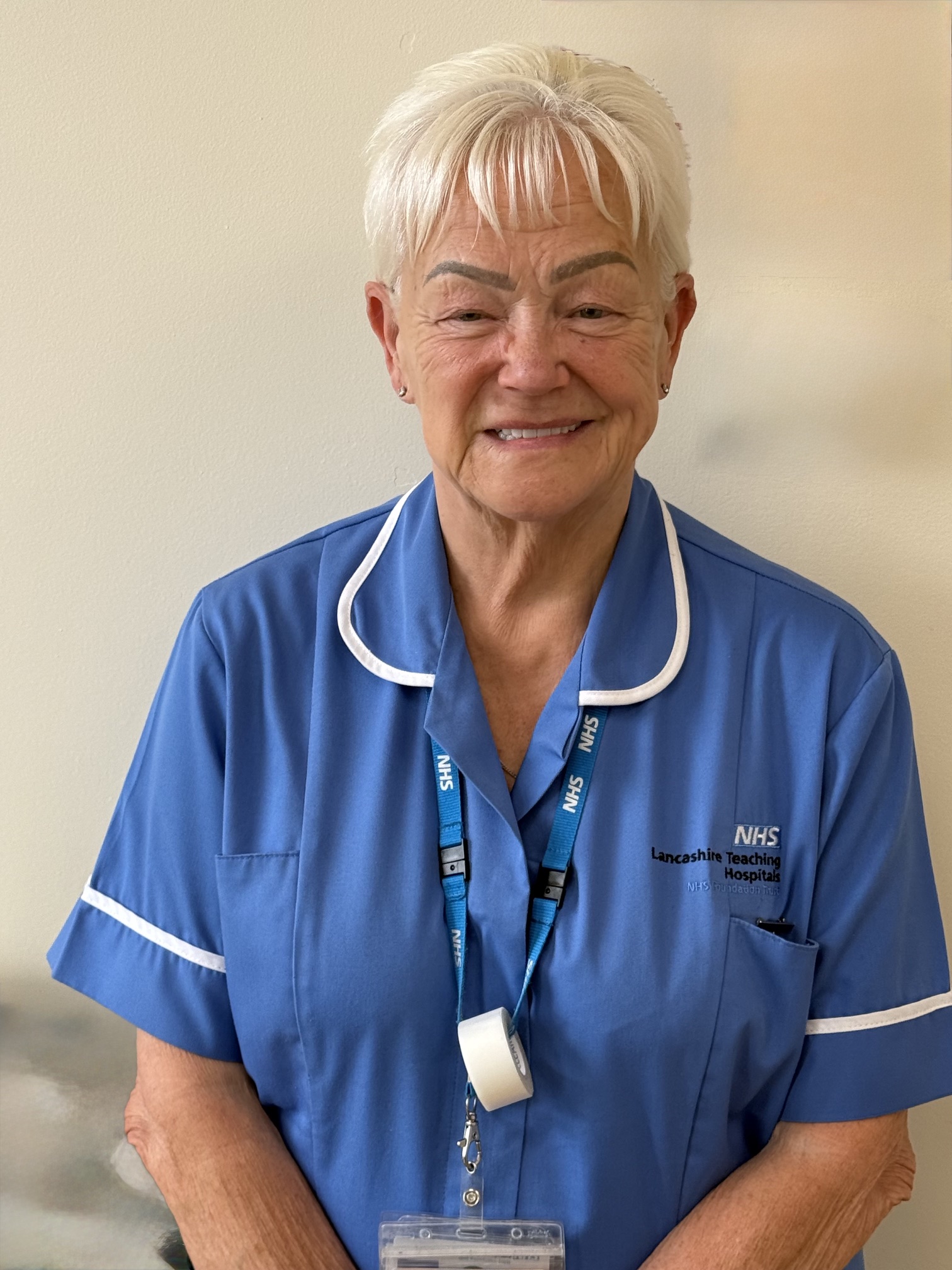
 When Julie Riley began her nursing career in 1976, the NHS was less than 30 years old. Now, after working across multiple hospitals, wards and generations of nursing staff, she is celebrating an extraordinary 50 years of service.
It is a milestone few people reach, and one that Julie reflects on with a mixture of pride, gratitude and affection for the countless colleagues and patients who have shaped her career.
Growing up in Bolton as the eldest of three children, nursing was her dream from an early age. She had also earned a place at art school and hoped to study interior design, but family circumstances meant she needed to go out to work.
"My passion was nursing," she recalls. "I never really wanted to do anything else."
Julie began her career at Heath Charnock Hospital in 1976 and remained there for many years as an auxiliary nurse.
As services changed and sites closed, she moved between hospitals and wards, adapting to each new chapter while continuing to care for patients.
She then moved to Eaves Lane Hospital in Chorley, until that closed around 2000, and she came to Chorley and South Ribble Hospital, enjoying a significant time on Rookwood before moving to Astley Ward, and then Brindle Ward, a respiratory ward.
One conversation on Brindle Ward would change the course of her career.
By then in her early fifties, Julie was called into the office by her ward manager, Alex Lincoln.
"He told me he'd seconded me to do my nurse training," she says. "I told him to reconsider because I hadn't studied for years and years. But he wouldn't change his mind."
Out of around 80 applicants across Chorley and Preston, only six training places were available. Julie secured one of them. What followed became one of the proudest achievements of her life.
She enrolled at what was then the University of Central Lancashire (now the University of Lancashire) and embraced student life with enthusiasm and determination.
"I think I was the oldest in the group, but I took it very seriously," she says.
Her commitment paid off. After qualifying as a nurse, she became the only member of her cohort to return and complete a degree.
"I loved studying," she says. "If I'd been younger, I think I would have gone on and done a Master's degree."
The achievement carried particular significance because she became the first person in her family to attend university.
"No one else in my family had been to university, so I was really proud of that."
Throughout her studies and later nursing career, Julie remained grounded by the values that had first drawn her into the profession.
"No matter where I went on placement, I never told people I'd already been an auxiliary nurse for all those years," she says. "You never stop learning."
That willingness to learn has served her well throughout a career that has spanned enormous changes in healthcare.
She's seen wards evolve and technology transform working practices.
"It has changed beyond recognition," she says. "There's so much paperwork now and everything is much more business-like."
Yet despite the changes, she believes the most important thing has remained the same.
"The compassion is still there. People still want to help people."
It is the people, in fact, who stand out most when she reflects on five decades in the NHS.
"I've worked with some amazing people, far too many to mention."
Many of those friendships continue today. Julie organises regular gatherings with a group of former nursing colleagues she affectionately calls the "Ladies that Lunch".
Meeting every month, the group provides friendship, support and plenty of laughter.
"I didn't want people to feel forgotten when they retired," she explains. "Sometimes people leave work and you hardly see them again. I found that quite sad."
Some members of the group have known each other for more than 40 years.
Today, she continues to work two days a week and has no immediate plans to retire.