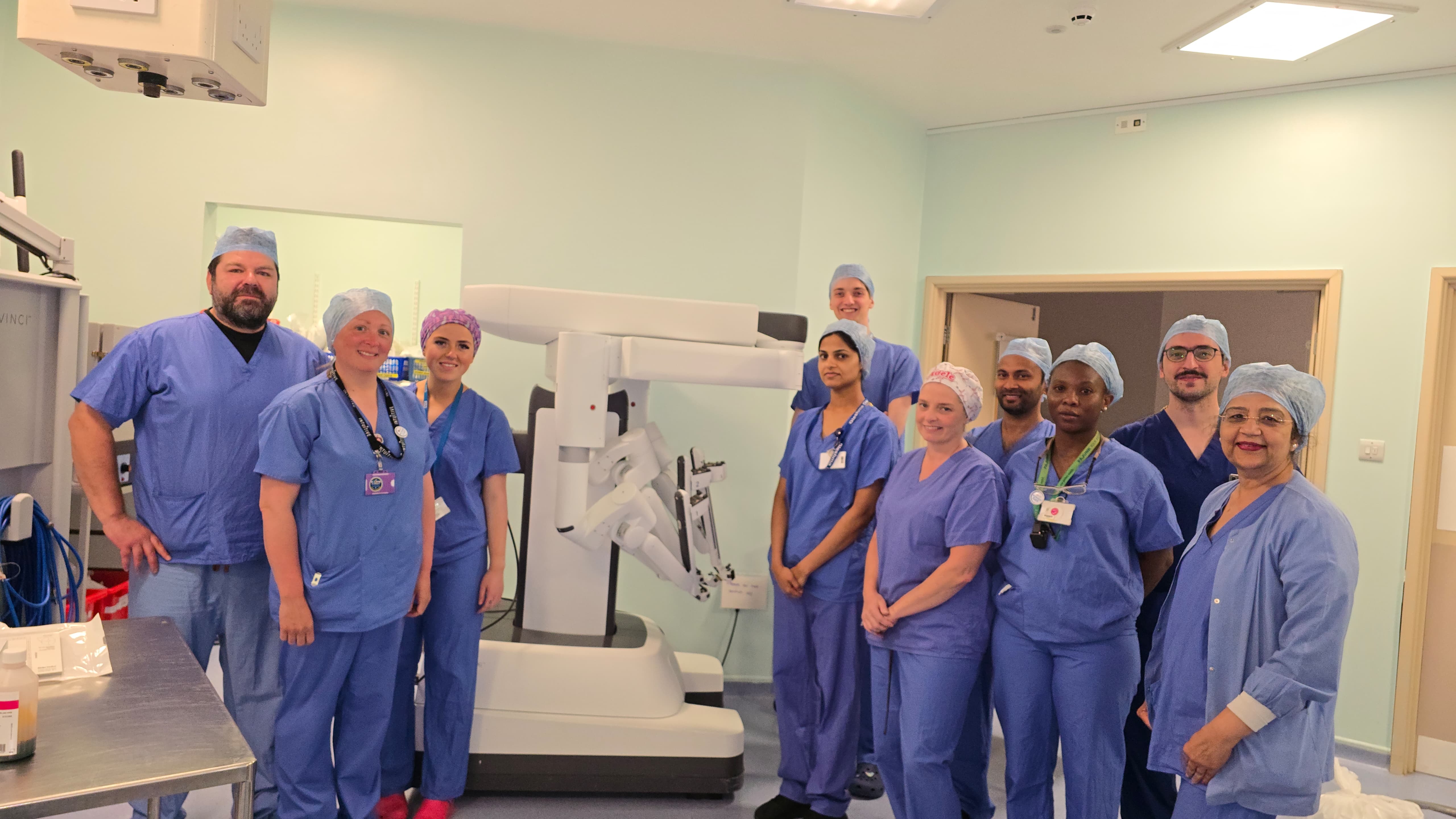
Lancashire Teaching Hospitals NHS Foundation Trust has become the first centre in the region – and one of just seven across the UK – to introduce robotic TAMIS (Transanal Minimally Invasive Surgery): a cutting-edge approach to treating early-stage rectal cancer and complex polyps.
The new technique enhances the Trust’s long-established regional Early Rectal Cancer service and reflects its continued commitment to investing in innovative technology and patient-centred care that directly benefits cancer patients in the region.
Robotic TAMIS preserves the rectum and anus and, in many cases, reduces the risk of a permanent stoma – a surgically-created opening on the surface of the body that connects to an internal organ, allowing waste to exit the body in a controlled way.
The procedure uses the Da Vinci surgical robot and a robotic motion table, both generously funded by the Rosemere Cancer Foundation. To date, four successful robotic TAMIS operations have been performed by the colorectal team – one benign case at Royal Preston Hospital and three cancer cases at Chorley and South Ribble Hospital.
Mr Ioannis Peristerakis, Consultant Colorectal Surgeon, said:
“This is a significant step forward in how we manage early rectal cancer and large polyps. Robotic TAMIS allows us to offer more precise, minimally invasive treatment, enabling patients to avoid major surgery and preserve normal bowel function.
“The motion table allows the robot and operating table to move together safely and in sync, increasing both precision and safety.
“The generous support of the Rosemere Cancer Foundation has enabled our specialist robotic centre to deliver innovations and push the boundaries in delivering high quality patient care.”
The motion table technology, funded by Rosemere at a cost of approximately £300,000, is key to facilitating robotic TAMIS and a number of other major robotic operations. Unlike standard operating tables, the motion table works in harmony with the robotic arms, reducing risk and improving surgical outcomes. Lancashire Teaching Hospitals now has two motion tables – one at Preston and one at Chorley.
“We’ve offered TEMS (the standard version of Robotic TAMIS) for over 17 years,” Mr Peristerakis added. “Now, with robotic TAMIS, we can push the boundaries in early rectal cancer surgery, treating more complex cases, safely and with greater flexibility.
“It also helps us improve patient flow – recently, we were able to treat a patient within a few days from referral, when typical waiting times can be substantially longer.”
The decision to offer robotic TAMIS at Chorley and South Ribble Hospital reflects a strategic use of available resources and helps reduce pressure on the main robotic theatre at Royal Preston Hospital.
“Nationally, there’s growing use of robotic surgery, but our focus is to ensure it brings real, measurable benefits to patients.”
This local innovation aligns with NHS England’s plans to expand robotic surgery as part of a national strategy to reduce waiting times and improve surgical outcomes.
By 2035, NHS projections show that up to 500,000 operations a year will be robot-assisted – a significant increase from 70,000 in 2023/24. Currently, around 1 in 5 keyhole surgeries involve robotic assistance; that figure is expected to rise to 9 in 10 over the next decade, with robotic surgery becoming the default approach for many procedures.
Emergency surgeries are also expected to increasingly benefit from robotic technology, which offers a level of precision that can exceed the capabilities of the human hand.
At Lancashire Teaching Hospitals, robotic surgery has been in use since 2017, particularly using the da Vinci Xi system, and the Trust recently completed its 1,000th robotic prostatectomy.
“It’s all about using this technology where it genuinely benefits patients,” said Mr Peristerakis. “While robotic technology allows us to perform a wide range of procedures, we focus only on those that bring real value to patient care.
“We are focused on improving patient outcomes and experiences by optimising the use of cutting-edge technologies.”
As a tertiary referral centre for early rectal cancer, Lancashire Teaching Hospitals now offers robotic TAMIS as a powerful new option to safely remove cancers and large polyps without major surgery. This innovation improves care, access, and outcomes for patients across Lancashire and South Cumbria.