Organ Donation Awareness Week is a time to reflect on the extraordinary impact of organ donation and the lives it transforms.
Behind every transplant is a story of hope, loss, and generosity - often untold, but always profound.
In the following account, one kidney recipient - Sue, from Lindale, Cumbria, who receives renal care from Lancashire Teaching Hospitals - shares her deeply moving journey, offering a rare glimpse into the emotional reality of receiving the gift of life.
It’s a reminder that organ donation is not just a medical procedure, it’s an act of compassion that connects strangers in the most intimate and life-affirming way.
Sue's story
The call came at one o’clock in the morning. I gathered a few things, rang my friend and arranged to drop off Sam, my beloved dog. Few words were exchanged, “Good luck, don’t worry about Sam”. They understood.
We began the drive to Manchester, and, of course, fate would have it that when we got to junction 36 of the M6 that the southbound slip road was closed for maintenance. We were forced to go north to junction 37 and then come back down.
I don’t recall speaking, consumed by thoughts, without sharing them. I remember feeling irrepressible sadness, I was on my way to Manchester Royal Infirmary and it was a certainty that somebody else was driving away from some other hospital feeling a raw and devastating loss. Unfortunately that is the essence of this process.
Had this person carried a donor card or had her family made this decision when they were told there was to be no recovery for their girl?
For seven and a half years I had haemodialysis at home and this phase of my story was coming to an end. A few days later I met the lady on the ward who had received the other kidney. It’s likely that other patients elsewhere had gained a heart, a pancreas, corneas maybe, or a liver.
The effect of organ donation is far-reaching and the transformation to lives, not only of the recipients, but also for those around them, is immeasurable. For my part I am certain that I would have departed this life some time ago without my transplanted kidney.
The surgeon told me that the donor was female and a veiled reference was made to her just being old enough to hold a driving licence. No vascular disease, a symptom of youth. Given the hour, I guessed that this girl met her end in a car accident.
By chance, some years later, I met a retired theatre nurse, she told me that donors were treated with the utmost respect when body parts were removed. That has always been of great comfort to me.
On Bonfire Night, two days before my 41st birthday, I received the gift of a lifetime. No more fluid restrictions, I was able to quench my thirst, a basic human need. No more eight hour dialysis sessions. I became re-acquainted with soft summer fruits. I was stronger, felt so well and hadn’t realised how far below par I had been. The whole experience was completely overwhelming.
On the morning of my discharge, a woman a little older than me came to the ward with her husband. She had had the nod. Her turn to sit and wait to go to theatre. Suddenly there was a lot of noise and chatter. A group of visitors walked to her bedside carrying balloons, cards, flowers and every possible celebratory frippery available. Apart from being rather previous. I considered it wholly inappropriate.
They seemed to be completely insensitive to the juxtaposition in which they found themselves. A precious thing was coming their way but at enormous cost to some anonymous family.
These come without wrapping or ribbons. They are donations that do not come in the form of unwanted clothes or kitchen equipment. They do not fit in an envelope or through the slot on the top of a plastic container with a logo on the side. They cannot be accumulated by running a marathon for sponsorship. There are long lists of names of people waiting for them, some of them clinging to an existence of suffering, hoping to be rescued.
I cannot think of the success of my transplant without thinking of that young woman, they are indelibly linked. As a person she is lost forever, grieved, missed, and sometimes it is hard to conceive that part of her lives within me. She has never shown signs that she objects to her new dwelling. In the midst of all this I am mindful that this is not an exchange of life, one for one, the fate of my donor was already sealed.
Each day her kidney continues to function within me, my life is her life and hers mine. Every moment of every day she filters my blood and monitors the levels of nutrients, and secretes what is not required. She has never missed a beat. What would her life have been, would she have been a wife, a mother? What colour was her hair, her eyes? What did she do for a living? What mark would she have made on the world? I will never know the answers to these questions.
I am, however, certain of something. I have decided it is a very personal message, a small detail, a clue. I have no other explanation. Two days after my transplant surgery, one of the nurses placed a cup on the table in front of me. I raised it to my lips. The smell was unfamiliar and I asked her ”what is it?” She looked puzzled, “tea”. I tasted it and the flavour too was completely unrecognisable. It was palatable, pleasant in fact.
For my entire life I had detested both the smell and taste of tea, but this had neither characteristic of the dreaded beverage. Hot steam escaping from a freshly brewed pot was enough to make me recoil. My parents both drank endless cups of tea and I married a man who has never been known to refuse one. These days, although I still prefer the taste of coffee, I probably drink about three cups a day. I think she was a tea drinker.
The surgeon told me that it only took two hours to perform the transplant, said he’d never done one in so little time, they normally take a minimum of four hours. I am her custodian. I am old enough to be her mother. I am her beneficiary. Our paths crossed and now we travel as one.
I can only speculate as to the feelings of families when faced with a choice of organ donation, some may find solace, but for others it may be too devastating to contemplate. The deep regard I have for her, and her family, for the choice they made in this inordinate act of kindness is indescribable.
I am grateful for my prolonged life and will always them remember with affection. Occasionally when I fill the kettle and shout “Should we have a cup of tea?”, I am reminded that I am not entirely myself.
As we mark Organ Donation Awareness Week, let us remember the countless individuals waiting for a second chance at life, and the families who, in their darkest moments, choose to give others light.
Organ donation is a legacy of love - one that lives on in every heartbeat, every breath, and every cup of tea.
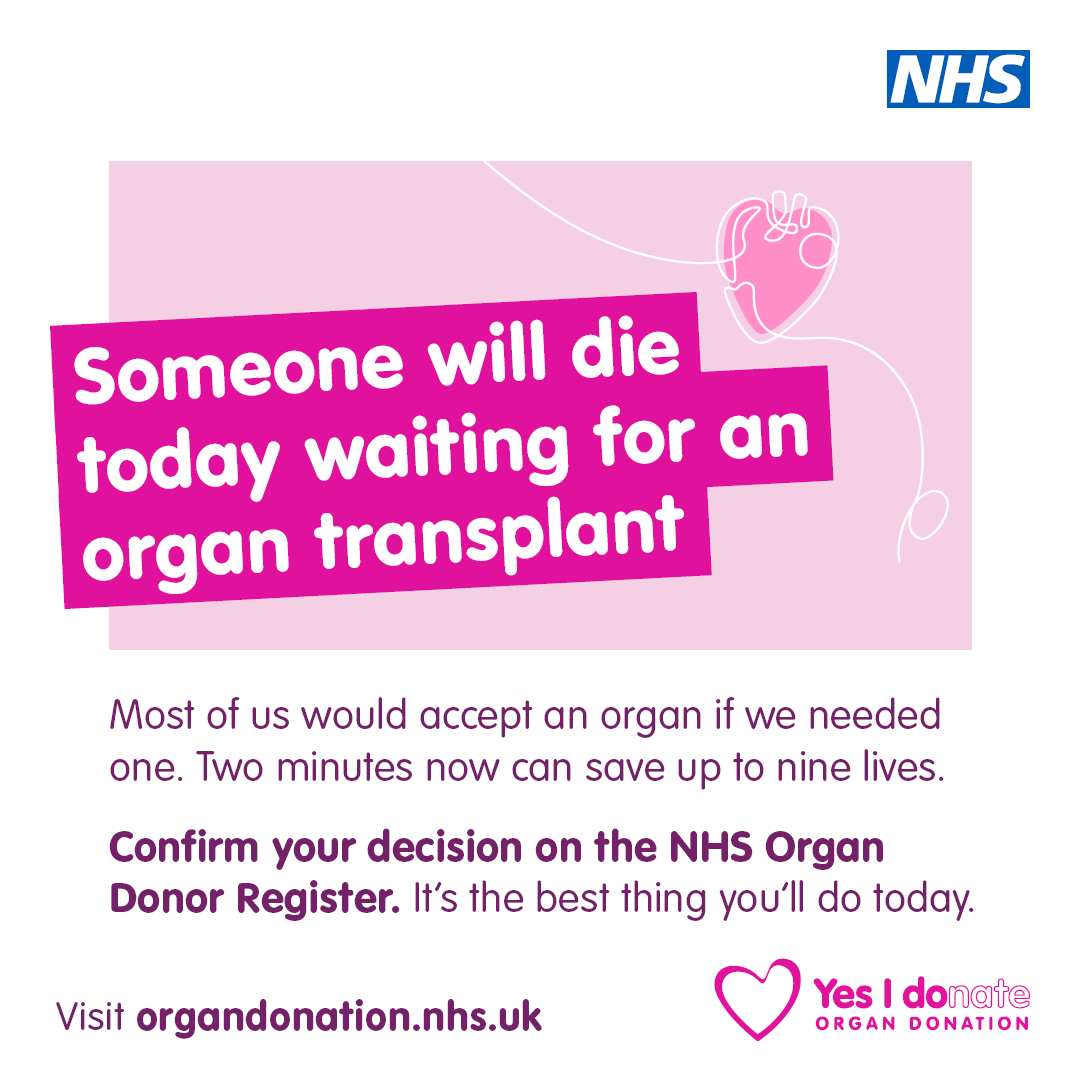
If you haven’t already, please consider joining the NHS Organ Donor Register and talk to your loved ones about your wishes.
Your decision could one day mean everything to someone else.